Hard Disks and Hard Drives in Computers: Powerful Pros and Cons
Published: 11 Mar 2026
Is a hard disc the same thing as a hard drive, or do they work differently? This confusion leads many users to search for hard disks and hard drives in computers. I had the same question when I upgraded my first computer and planned to store important work files.
I chose the wrong option at first and faced slow speed and storage issues. Later, I learned how storage types work and how they affect performance. After that, choosing the right storage became easy and stress-free. Now I always check storage needs before buying or upgrading any computer.
What Is a Hard Disc/Hard Drive?
A hard disc, sometimes referred to as a hard drive or HDD (Hard Disc Drive), is a part of a computer that is used to permanently store digital data. This implies that the data stays alive even after your computer is turned off.
Everything is stored there, including Windows files, games, movies, schoolwork, applications, and private information. The hard drive protects your data until you remove it or replace the disc, in contrast to RAM, which erases data when the computer shuts down.
How Does a Hard Drive Work?
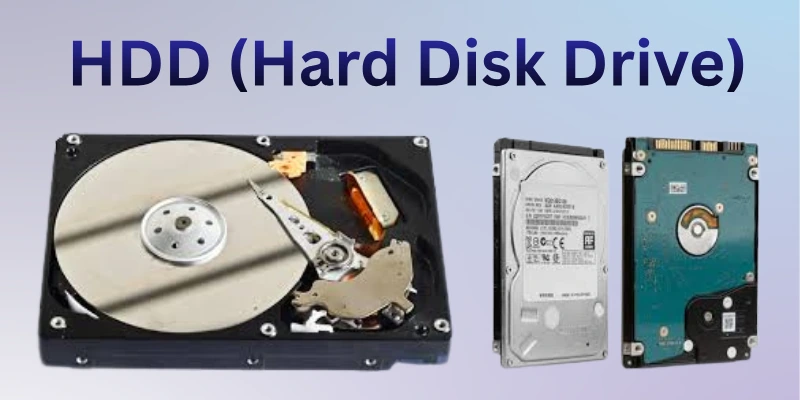
- A hard drive functions similarly to a record player. The drive contains:
- Platters (data storing circular discs)
- Head for reading and writing (like a little needle)
- The motor that rotates the platters
- Magnetic cover (information storing)
- This is the easy procedure:
- The platters rotate quickly typically at 5400 or 7200 RPM.
- To read or write data, the head passes over them.
Types of Hard Disks
Hard drives are classified according to their size, connection and technology. Selecting the best drive for your computer is made simple by being aware of these.
The hard disc protects your data when the computer shuts down until you remove it or replace the drive.
1. HDD (Hard Disk Drive)
This is a traditional hard disc that contains mechanical components.
It offers huge storage capacity ranging from 500GB to 10TB and is comparatively slower than SSDs due to its moving parts.
Because the internal platters spin while operating, it can also produce noticeable noise.
Overall, it is an ideal choice for budget-friendly PCs, as well as storing movies, backups, and general home-use data.
2. SSD (Solid State Drive)
Despite not being a disc, SSDs are the modern replacement for traditional HDDs.
They are extremely fast, have no moving parts, and are both durable and lightweight.
However, they are more expensive per GB compared to HDDs.
Overall, SSDs are ideal for professional work, editing software, gaming, and achieving fast startup time
3. Hybrid Drives (SSHD)
A hybrid drive combines both SSD and HDD technologies.
It is faster than a traditional HDD and more affordable.
able than a full SSD. It works by storing frequently used files in the SSD portion for quicker access.
Overall, it is ideal for users who want a balance of speed and storage at an affordable price.
4. External Hard Drives
These are USB-connected external drives.
Specifications:
- Useful for backups
- Excellent for transferring and storing data
- Convenient for travel
Typical Hard Drive Sizes:
There are two main physical sizes of hard drives:
3.5 inches:
- Commonly used in desktop computers
- Larger in size
- Usually offers higher RPM (speed)
- Provides more storage capacity
2.5 inches:
- Commonly used in laptops
- Smaller and more compact
- Consumes less power
Where Is the Hard Drive Used?
These are USB-connected external drives.
Specifications:
- Useful for backups
- Excellent for transferring and storing data
- Convenient for travel.
Typical Hard Drive Sizes:
There are two main physical sizes of hard drives:
3.5 inches:
- Commonly used in desktop computers
- Larger in size
- Usually offers higher RPM (speed)
- Provides more storage capacity
2.5 inches:
- Commonly used in laptops
- Smaller and more compact
- Consumes less power
Advantages of Hard Disk Drives (HDD)
HDDs continue to be popular due to a number of advantages:
1. Large Storage Capacity: Large files can be stored on affordable 1TB or 2TB hard drives.
2. Affordable
SSDs are more costly than HDDs. They are therefore ideal for people who require a lot of storage or for low-cost PCs.
3. Extended Life (when used properly)
An HDD can last four to seven years, or possibly longer, with typical use.
4. Simple Replacement
HDD upgrades are supported by the majority of PCs, and even novices may easily install them.
5. It’s Easy to Recover Data
Because the data is magnetically stored, data recovery is frequently achievable in the event that an HDD dies.
Disadvantages of Hard Drives
HDDs are useful, but they also have several disadvantages:
- Slow Speed
HDDs read and write data much slower than SSDs because they use mechanical parts. - Heat and Noise
The rotating disc and moving components can generate heat and produce noise over time. - More Damage-Prone
HDDs can be easily damaged if dropped or hit because they contain sensitive moving parts. - Longer Boot Time
Computers with HDDs take longer to start compared to SSD-based systems. - Higher Power Usage
HDDs use more electricity, which results in shorter laptop battery life.
2.5-Inch HDDs
- Commonly used in laptops
- Smaller and more compact
- Use less power
Signs Your Hard Disk May Be Failing
Warning indications of a failing hard drive include:
- Reduced speed of computer operation
- Sounds of clicking or grinding
- System freezing frequently
- Files that take a long time to open
- corruption of data
- The drive is not recognised by the computer.
How to Take Care of Your Hard Drive
Don’t shake or drop your laptop.
Store your computer somewhere cool.
To prevent corrupted files, use antivirus software.
Every month, defragment your HDD.
Maintain a minimum of 10% to 20% of the space free.
Steer clear of rapid shutdowns.
Regularly back up important files.
Proper maintenance lowers the chance of data loss and lengthens lifespan.
Hard Disk vs Solid State Drive (HDD vs SSD)
| Feature | HDD | SSD |
| Speed | Slow | Very fast |
| Parts | Mechanical | No moving parts |
| Noise | Yes | Silent |
| Lifespan | Moderate | High |
| Cost | Cheap | Expensive |
| Best for | Storage | Speed & performance |
Conclusion
In this guide, we have covered hard disks and hard drives in computers. I suggest balancing storage needs with awareness of limits like data loss and hardware failure. We can manage these risks by keeping backups, checking storage health, and using drives properly.
Thank you very much for reading, and I truly appreciate your time and attention. Don’t skip the next part of the FAQs. I hope you will find something more interesting, so don’t miss it. If you miss it, you may lose something new.
FAQs: Hard Disks and Hard Drives in Computers
Let’s look at some frequently asked questions about hard discs and hard drives in computers to better understand how they store data and work in a system.
Hard disks and hard drives are storage devices used in computers to store data permanently. They keep your operating system, software, files, photos, and videos safe even when the computer is turned off. A hard disk drive (HDD) uses spinning disks to store data. It is one of the main components of computer storage.
The main function of a hard disk is to store and retrieve digital data. It saves files such as documents, images, programs, and the operating system. When you open a file, the computer reads it from the hard drive. Without a hard disk, a computer cannot store information long-term.
A hard disk drive works using spinning magnetic disks called platters. A small read/write head moves across the surface to store or read data. When you save a file, the computer writes data on the platters. When you open a file, the drive quickly reads the stored data.
A hard drive is important because it stores all the computer’s data and programs. It keeps files safe even when the power is off. The operating system also runs from the hard drive. Without it, the computer would not be able to save or load information.
The main types of hard drives are HDD, SSD, and hybrid drives. HDDs use spinning disks to store data and are usually cheaper. SSDs use flash memory and are much faster. Hybrid drives combine both technologies for better performance.
Modern hard drives usually offer storage from 500 GB to several terabytes. A terabyte (TB) can store thousands of files, photos, and videos. Larger drives are useful for gaming, video editing, and backups. The storage capacity depends on the computer’s needs.
Hard drive storage refers to the space where data is saved permanently. It stores operating systems, applications, and personal files. This storage remains even after the computer is turned off. It is different from RAM, which stores temporary data.


- Be Respectful
- Stay Relevant
- Stay Positive
- True Feedback
- Encourage Discussion
- Avoid Spamming
- No Fake News
- Don't Copy-Paste
- No Personal Attacks
- Be Respectful
- Stay Relevant
- Stay Positive
- True Feedback
- Encourage Discussion
- Avoid Spamming
- No Fake News
- Don't Copy-Paste
- No Personal Attacks
