What Is a Hybrid Computer Powerful Benefits and Hidden Risks
Published: 10 Mar 2026
Many learners struggle to understand computer types because books explain them in a complex way. This problem pushes users to ask what is a hybrid computer? I faced the same confusion during my early studies and practical learning sessions. Definitions felt unclear, and examples felt disconnected from real use.
Later, I saw how hybrid computers work in real systems like medical machines and weather tracking tools. Simple real-life examples helped me understand how analog speed and digital accuracy work together. After that, the concept became clear and easy to remember.
Definition of Hybrid Computer
A hybrid computer is a type of computer that combines features of both analog and digital computers. The word hybrid stands for a mix of two different systems working together. This computer can handle numbers that change continuously and also process exact values.
It uses analog parts to measure real world data like temperature or speed. It uses digital parts to store data and perform calculations. Hybrid computers work fast and give accurate results. People often use them in hospitals, research centers, and scientific labs. This combination makes them useful for complex tasks.
Key Features of Hybrid Computers
Hybrid computers are special because they mix the strengths of different systems to solve real-world problems. They handle fast changes and also give clear results. This makes them useful in areas like health, science, and control systems.
Combination of Analog and Digital Processing
Hybrid computers use both analog and digital methods to work. The analog part handles continuous data like speed or temperature. The digital part processes numbers and gives clear results. Together, they make the system more powerful and flexible.
- Handles real-world signals and data
- Gives clear digital results
- Combines speed with accuracy
- Works well for complex tasks
- Useful in medical and scientific systems
Real-time Operation
Hybrid computers work in real time, which means they respond instantly to changes. They process data as it comes in. This helps in situations where quick action is needed.
- Gives instant results
- Responds to live data
- Helps in monitoring systems
- Useful in control tasks
- Keeps systems running smoothly
Accurate and Fast
Hybrid computers are both quick and accurate in their work. They process data fast and still give correct outputs. This balance makes them reliable for important tasks.
- High speed processing
- Good level of accuracy
- Saves time in operations
- Reduces chances of error
- Ideal for time-sensitive work
Use of Sensors + CPUs
Hybrid computers use sensors to collect data from the real world. The CPU then processes this data and gives results. This link helps turn physical signals into useful information.
- Collects data from sensors
- Converts signals into numbers
- Processes data with CPU
- Helps in monitoring and control
- Used in medical and industrial tools
How Hybrid Computers Work
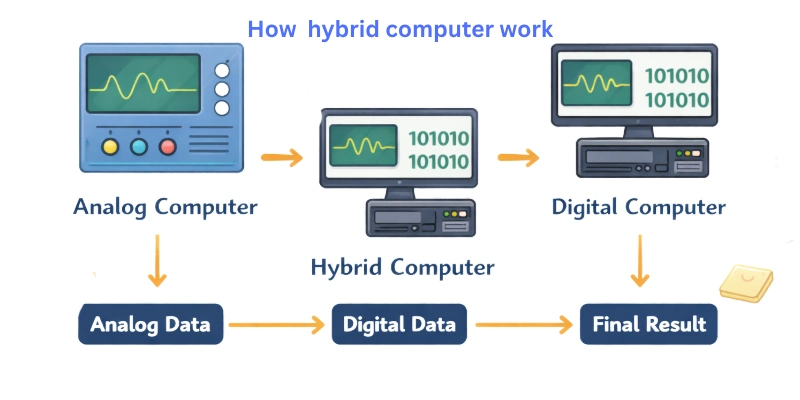
Hybrid computers combine analog and digital systems to handle real-world data and process it quickly. They take signals from the environment, convert them, and then make smart decisions. This mix helps them work well in tasks that need both speed and accuracy.
Step-by-step working of a hybrid computer
- Data input from sensors (analog signals)
Sensors collect data like temperature, pressure, or heart rate. This data comes in as smooth, continuous signals from the real world. - Conversion using ADC (Analog-to-Digital Converter)
The ADC changes the analog signal into digital form. This allows the computer to understand the data as numbers. - Digital processing by CPU
The CPU processes the digital data using programs. It analyzes the numbers and decides what action to take. - Control and decision making
Based on the processed data, the system makes a decision. It may compare values or check limits to control the next step. - Output or action using DAC (if needed)
If required, the DAC converts digital data back into analog signals. These signals control machines, displays, or other devices.
Why this method is useful:
This working method is useful because it handles real-world signals and still gives clear digital results. It allows fast response and accurate control at the same time. That is why hybrid computers are used in medical machines, weather systems, and industrial control where quick and reliable actions matter.
Examples of Hybrid Computers
Hybrid computers combine analog and digital computing to handle real-time data with high accuracy. They are useful in systems where fast signals from the real world must be processed and analyzed by computers. This makes them ideal for medical, aviation, and industrial applications.
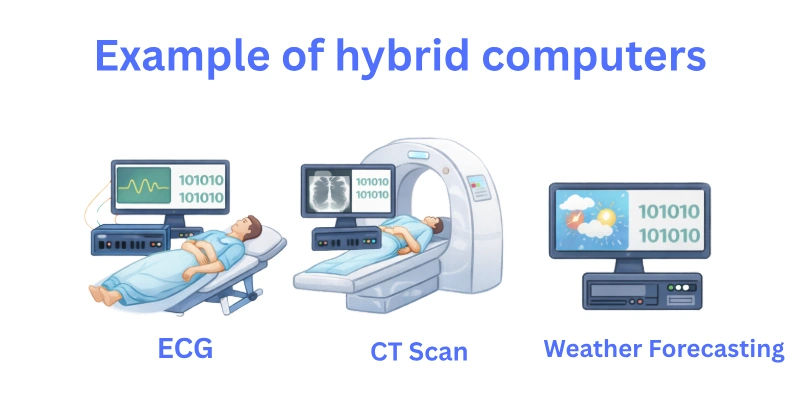
Medical Devices (ECG and EEG Machines)
ECG and EEG machines are used in hospitals to check heart and brain activity. Sensors pick up tiny electrical signals from the body, which are analog in nature. These signals are then converted into digital data so computers can display graphs and analyze problems. Hybrid computing is important because doctors need both real-time signals and accurate digital reports for diagnosis.
- Used to monitor heart and brain activity
- Body signals work as the analog part
- Computer analysis and display are digital
- Gives fast and accurate medical results
Flight Simulators
Flight simulators train pilots by creating a realistic flying environment. The movement and control responses behave like real aircraft and act as the analog part. The software that calculates flight conditions and shows visuals is the digital part. Hybrid computers are important here to provide smooth real-time motion with precise calculations for safe training.
- Used for pilot training
- Motion system works as analog
- Software and displays are digital
- Creates safe and realistic practice
Industrial Control Systems
Industrial control systems are used in factories to control machines and processes like temperature and pressure. Sensors measure physical values, which are analog signals. These are converted and processed by digital computers to make decisions and control machines. Hybrid computing is important to keep operations fast, safe, and efficient.
- Used to control factory machines
- Sensors provide analog signals
- Computers handle digital control
- Improves safety and efficiency
Difference Between Hybrid, Analog, and Digital Computers
Understanding the comparison between analog, digital, and hybrid computers matters because each type has a different use and strength. This knowledge helps beginners choose the right computer for the right task.
Analog Computers
Analog computers work with continuous data such as temperature, pressure, or speed. They handle real-time changes very fast. However, they offer lower accuracy and limited storage. Devices like thermometers and speedometers are simple examples of analog computers.
- Work on continuous data
- Process real-time changes very fast
- Provide lower accuracy
- Commonly used in measurement devices
Digital Computers
Digital computers work with discrete data in the form of 0 and 1. They give very accurate results and store large amounts of data. Laptops and smartphones are common examples. People use digital computers most for daily tasks.
- Work on 0 and 1, which is discrete data
- Provide very accurate results
- Offer large storage capacity
- Best for general-purpose use
Hybrid Computers
Hybrid computers combine analog and digital features. The analog part collects real-world signals, and the digital part processes them. This combination provides both speed and accuracy. Medical and industrial systems often use hybrid computers.
- Combine analog and digital systems
- Provide fast and accurate processing
- Used in complex systems
- Common in medical and industrial fields
Advantages of Hybrid Computers
Hybrid computers combine the benefits of both analog and digital systems. They are designed to handle real-world signals quickly while also providing accurate digital results. This makes them very useful in fields where speed and precision are both important.
Fast Processing
Hybrid computers can process real-time signals very quickly because the analog part handles continuous data from sensors immediately. This allows systems to respond to changes almost instantly.
- Analog part handles data in real-time
- Quick response to changes in signals
- Ideal for systems needing immediate output
- Reduces delay in critical processes
Real-time Accuracy
The digital part of hybrid computers ensures that the results are precise. This combination allows users to get accurate readings without waiting, which is crucial in medical or industrial applications.
- Digital processing ensures precise results
- Real-time output with high accuracy
- Reduces errors in critical tasks
- Useful in healthcare and safety systems
Versatile Applications
Hybrid computers are used in many areas because they can handle different types of tasks. From medical devices like ECG machines to flight simulators and industrial systems, their flexibility makes them highly useful.
- Works in medical, industrial, and aviation fields
- Can handle multiple tasks at once
- Suitable for complex and critical systems
- Adapts to different types of input and output
Efficient Data Handling
Hybrid computers can process both continuous analog data and discrete digital data efficiently. This means they can measure real-world signals and also store, analyze, and make decisions quickly.
- Handles continuous and discrete data
- Combines measurement and calculation
- Efficient for monitoring and control systems
- Saves time and improves productivity
Disadvantages of Hybrid Computers
Hybrid computers offer many advantages by combining the strengths of analog and digital systems. However, they also come with certain limitations that make them less practical for general use.
Understanding these disadvantages helps beginners see why these computers are mostly limited to specialized fields like medical, industrial, or research applications.
High Cost
Hybrid computers are more expensive than purely analog or digital computers. This is because they require both analog and digital components, which increases manufacturing expenses.
Maintenance is also costly because specialized parts and regular calibration are needed to keep the system accurate. Additionally, upgrades and repairs demand skilled technicians, further adding to the cost.
- Manufacturing involves both analog and digital components
- Maintenance and calibration are expensive
- Repairs and upgrades require skilled technicians
- Overall cost is high compared to single-type computers
Complex Design
The architecture of hybrid computers is more complicated than other types of computers. Mixing analog and digital systems means more connections, circuits, and control mechanisms. Operating, troubleshooting, and maintaining such systems requires specialized knowledge and training. Even small errors in the system can cause malfunctions, making it harder to manage than simpler computers.
- Combines analog and digital architectures
- More circuits and control systems involved
- Skilled personnel needed to operate and maintain
- Mistakes in design or operation can affect performance
Limited Consumer Use
Hybrid computers are rarely used for personal or everyday purposes. They are primarily designed for environments where both speed and accuracy are crucial, such as hospitals, industrial plants, or research laboratories. Because of their cost and complexity, they are not suitable for offices, schools, or home use. Their applications are usually very specific and task-oriented.
- Mainly used in medical, industrial, and research fields
- Not common for offices, homes, or general consumers
- Applications are specialized, not general-purpose
- Accessibility is limited due to cost and complexity
How to Hybrid Technology vs Digital or Analog
Choosing the right type of computer depends on what you need it for, how accurate the results must be, and how much you are willing to spend. Analog, digital, and hybrid systems each have their own advantages and limitations. Understanding these differences helps beginners make the best choice for different applications.
When to Use Hybrid Systems
Hybrid computers are best when both speed and accuracy are required. For example, medical devices like ECG and EEG machines need instant readings but also precise data for diagnosis. Similarly, flight simulators and industrial control systems require fast response to changing conditions while performing complex calculations. These scenarios benefit from hybrid systems because they combine real-time analog input with accurate digital processing.
- Ideal for tasks requiring both speed and accuracy
- Common in hospitals, industrial plants, and aviation
- Can handle multiple types of signals at once
- Ensures safe and reliable operations in critical applications
Problems They Solve Best
Hybrid computers excel at solving problems that involve both continuous and discrete data. They can take real-world analog signals, process them digitally, and provide immediate, precise output.
This makes them very effective for monitoring, control, and analytical tasks where timing and correctness are equally important. They reduce errors, save time, and provide reliable results in real-world systems.
- Combine analog input with digital processing efficiently
- Handle continuous and discrete signals simultaneously
- Solve complex monitoring and control problems
- Provide accurate, real-time results for critical tasks
Cost vs Benefit Comparison
Hybrid computers are more expensive to build and maintain than purely analog or digital systems. However, the investment is worth it in specialized applications where both speed and accuracy are essential.
Analog systems are cheaper but less precise, while digital computers are highly accurate and versatile but may not handle real-time physical signals effectively. Choosing the right system depends on the type of task, required accuracy, and budget.
- Hybrid systems are costly but versatile and precise
- Analog systems are low-cost but limited in accuracy
- Digital systems are accurate and flexible but not always real-time
- Choose based on task requirements, accuracy needs, and cost
Conclusion
In this guide, we have covered what is a hybrid computer. From my experience, balance comes from using hybrid computers for complex tasks and not for simple needs. We can manage limitations by training users properly and monitoring system performance.
Thank you for staying with this guide, and I wish you a smooth learning experience. Don’t skip the next part of the FAQs. I hope you will find something more interesting, so don’t miss it. If you miss it, you may lose something new.
FAQs: What Is a Hybrid Computer
Readers often ask similar questions about what is a hybrid computer. The FAQs below explain the key points clearly.
A hybrid computer combines the features of both analog and digital computers. It can process continuous analog signals as well as discrete digital data. This allows it to handle real-world inputs and give precise results. Hybrid computers are designed for tasks where speed and accuracy are both important.
Yes, hybrid computers are still used, but mainly in specialized fields. They are common in medical devices, industrial control systems, and flight simulators. These computers are preferred where real-time data and high accuracy are essential. For everyday use, digital computers are more commo
.
Hybrid computers combine analog and digital processing, while embedded systems are usually digital devices built for a specific task. Embedded systems are found in appliances, cars, or small electronics. Hybrid computers handle complex calculations and real-time signals, which embedded systems usually do not
Hybrid computers are fast and accurate. They can process real-time signals while performing precise digital calculations. They are versatile and used in medicine, aviation, and industry. Their ability to handle both continuous and discrete data makes them very powerful.
Hybrid computers can be expensive to build and maintain. Their design is complex, so skilled personnel are required to operate them. They are not commonly used for general consumer tasks. Maintenance and repair can also be more difficult than digital-only systems.
Hybrid computers are rarely used in schools or offices. They are designed for specialized applications that need both speed and accuracy. Digital computers are better suited for everyday tasks like word processing, browsing, or gaming. Hybrid systems are usually too complex and costly for general use
Hybrid computers take analog signals from sensors and convert them into digital form for processing. The analog part handles real-world measurements, while the digital part performs calculations and stores results. This combination allows fast, accurate, and real-time processing
Yes, hybrid computers are fast because the analog component can handle continuous real-world signals immediately. At the same time, the digital part ensures precise calculations. This makes them faster than purely digital systems for certain real-time tasks.





- Be Respectful
- Stay Relevant
- Stay Positive
- True Feedback
- Encourage Discussion
- Avoid Spamming
- No Fake News
- Don't Copy-Paste
- No Personal Attacks
- Be Respectful
- Stay Relevant
- Stay Positive
- True Feedback
- Encourage Discussion
- Avoid Spamming
- No Fake News
- Don't Copy-Paste
- No Personal Attacks
