History of the Computer with Timeline and Key Facts Now soon
Published: 24 Mar 2026
Technology has changed the way we live, work, and communicate every day. The history of the computer shows how simple ideas grew into powerful machines that we now use for work, learning, and entertainment. From early tools that solved basic problems to today’s fast laptops and smartphones, computers have become an essential part of our lives.
Understanding this journey helps us appreciate the technology we often take for granted. In this article, we have covered the key developments, innovations, and milestones that shaped the computer into the tool we rely on today.
Let’s jump into the article and explore the fascinating journey of computers.
Early Basics of Computing
Long before modern devices existed, people searched for easier ways to solve problems and handle information. These early ideas laid the groundwork for the systems we now use every day. Understanding these beginnings helps explain how simple thinking turned into powerful computing concepts. This stage marks the true starting point of the computer’s journey.
Here is the list of early computing basics.
- Early Tools
- Mechanical Devices
- Human Computers
- Early Limitations
Each point below explains an early stage in this journey.
1. Early Tools
People began using tools to make counting and problem-solving easier in daily life. These tools helped track trade, time, and basic calculations. They did not need electricity or machines to work. Instead, they relied on human hands and thinking. These early tools made tasks faster and reduced mental effort. They also prepared people for more advanced systems later.
- Used for counting goods and money
- Helped manage daily records
- Improved accuracy in calculations
- Easy to carry and use
2. Mechanical Devices
As needs grew, people created devices that worked with moving parts. These machines reduced manual work and saved time. Gears and levers allowed more complex calculations. Users could solve problems faster than before. These devices showed how machines could assist human thinking.
- Operated using physical movement
- Increased calculation speed
- Reduced human effort
- Required regular maintenance
3. Human Computers
Before modern machines, people performed calculations as a full-time job. These individuals followed fixed rules to solve problems. Their work supported science, navigation, and research. Accuracy depended on skill and focus. This role proved the demand for automated systems.
- Worked in teams or offices
- Followed written instructions
- Used paper-based methods
- Supported major projects
4. Early Limitations
Early systems faced many challenges that slowed progress. They lacked speed and flexibility. Errors were common due to manual handling. Storage of information was also difficult. These limits pushed inventors to search for better solutions.
- Slow processing of data
- High chance of mistakes
- Limited storage capacity
- Required constant supervision
Mechanical Computing Devices
People wanted faster and more reliable ways to handle complex calculations. This need led to machines that used physical movement instead of manual counting. Gears, wheels, and levers played a key role in early problem-solving. These devices marked an important shift toward automated computing.
Here is the list of important mechanical computing devices.
- Counting Machines
- Gear-Based Calculators
- Early Design Concepts
- Practical Use and Limits
Let’s take a closer look at each of these.
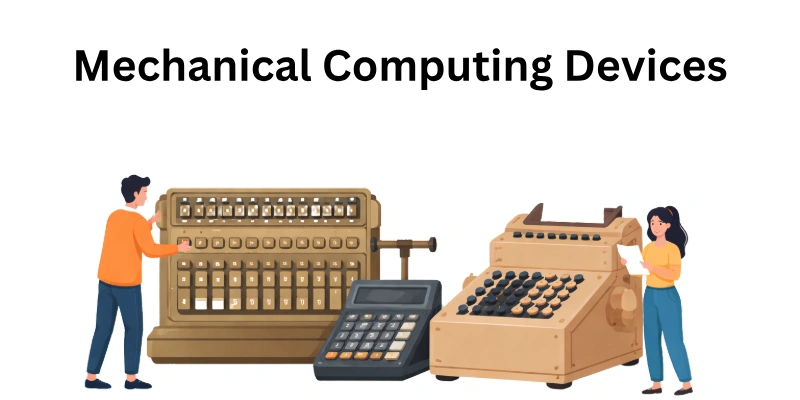
1. Counting Machines
Counting machines were among the first tools to automate simple arithmetic. They helped merchants, bankers, and accountants perform calculations faster. Instead of writing numbers manually, people could input values and get results quickly.
These devices reduced errors and improved efficiency in daily transactions. They marked the beginning of mechanical computation in practical life. Their use encouraged inventors to design more complex calculating systems.
- Used beads or rods for counting efficiently
- Simplified trade and financial record keeping
- Reduced mistakes in large numerical calculations
- Portable models allowed calculations on the go.
2. Gear-Based Calculators
Gear-based calculators introduced moving parts to handle more complex arithmetic automatically. These machines used interlocking gears to add, subtract, multiply, and divide numbers. They saved time compared to manual calculation and required less mental effort.
Engineers and scientists relied on these devices for technical problems. Gear-based systems demonstrated how mechanical principles could solve practical computing tasks. They laid the foundation for future mechanical computers.
- Operated with rotating gears and wheels
- Performed multi-step calculations quickly and reliably
- Enabled scientific and engineering applications efficiently
- Showed mechanical potential in automated computation
3. Early Design Concepts
Inventors developed early design concepts to improve calculation methods. These included ideas for combining parts, reducing human error, and increasing speed. Many concepts were theoretical before becoming working machines.
They focused on precision, repeatability, and practical usability. Designers studied previous tools and introduced new techniques to handle larger numbers. These concepts guided the evolution of computing devices over time.
- Focused on accuracy and efficient design
- Introduced modular systems for easier assembly
- Tested prototypes before practical implementation
- Inspired by later mechanical and digital machines
4. Practical Use and Limits
Despite their advantages, early mechanical devices had clear limits. They could perform only certain types of calculations. Machines require careful operation and regular maintenance to function properly.
Users needed skills to avoid mistakes. Space, cost, and speed were also significant constraints. Recognizing these challenges motivated inventors to improve designs and seek automation solutions.
- Limited to basic arithmetic operations only
- Needed trained operators for proper handling
- Regular cleaning and repair ensured performance
- Could not process complex or large data
The Start of Electronic Computing
The invention of electronic computers completely changed how people handled information. Machines no longer relied on gears or manual input alone. They could process data faster and more accurately than ever before. This shift opened new possibilities in science, business, and everyday life.
Let’s look at the main developments in this era.
1. Punch Card Systems
Punch card systems allowed computers to store and process information using cards with holes. Each card represented data or instructions that the machine could read automatically. This method made it possible to handle larger amounts of data than manual systems.
Businesses and research organizations adopted punch cards to organize records efficiently. Operators could quickly input, sort, and retrieve information. These systems set the stage for later advances in automated computing.
- Used for data storage and retrieval
- Enabled faster batch processing tasks
- Reduced errors compared to manual entry
- Supported early programming operations
2. Electromechanical Computers
Electromechanical computers combined electrical components with mechanical parts to perform calculations. They worked faster than purely mechanical machines and handled more complex tasks. Operators could automate sequences of calculations, reducing manual labor significantly.
Such machines became vital for military, engineering, and scientific projects. Reliability improved as engineers refined circuits and moving parts. This innovation bridged the gap between traditional machines and fully electronic systems.
- Used relays to control operations efficiently
- Required regular maintenance for smooth function
- Supported early code-based computation methods
- Laid the groundwork for modern electronic devices
Birth of Electronic Computers
Electronic computers changed the way people solved complex problems. They replaced mechanical systems with faster, more reliable electrical circuits. Scientists and engineers could now process large amounts of data in a fraction of the time. This development marked the beginning of modern computing as we know it.
Let’s explore the first electronic computers in detail.
1. ENIAC: First Electronic Computer
ENIAC, developed in the 1940s, is considered the first general-purpose electronic computer. It used thousands of vacuum tubes and occupied a large space. Although powerful for its time, ENIAC consumed a lot of electricity and generated heat.
2. Stored Program Concept
John von Neumann introduced the stored program concept, which allowed instructions and data to be stored in the same memory. This innovation made computers more flexible and efficient and became the foundation of modern computer architecture.
Generations of Computers
Computers have changed dramatically over time, evolving through distinct generations. Each generation brought new technology that made machines faster, smaller, and more reliable. Understanding these changes helps us see how computing advanced from simple devices to modern systems. The story of these generations reveals both innovation and the challenges inventors overcame.
Here is a list of computer generations.
- First-Generation Computer
- Second-Generation Computer
- Third Generation Computer
- Fourth Generation Computer
- Fifth Generation Computer
Let’s take a look at each generation of computers.
1. First Generation Computers(1940–1956)
The first generation of computers used vacuum tubes to process data. They were large, heavy, and required a lot of electricity. People used them mainly for scientific calculations and military tasks. Programming was done using machine language, which made them hard to operate.
Despite their size, they marked the beginning of modern computing. Early computers helped solve problems that were impossible to handle manually. These machines produced a lot of heat and needed constant cooling. Engineers and operators worked in shifts to keep them running smoothly.
2. Second Generation Computers(1956–1963)
The second generation replaced vacuum tubes with transistors. These machines were smaller, faster, and more reliable than their predecessors. They supported assembly language, making programming easier.
Businesses and universities began using them for data processing. Reliability improved, and machines required less maintenance. This generation made computers more accessible to professionals. They also consumed less power and produced less heat. Companies started integrating computers into regular office operations.
3. Third Generation Computers(1964–1971)
Integrated circuits replaced transistors in the third generation. Computers became even smaller, faster, and more powerful. They could handle multiple tasks at once, improving efficiency. Programming languages like COBOL and FORTRAN became popular.
Schools, offices, and research labs adopted these machines widely. This generation laid the foundation for modern operating systems. Users could now share programs and data between computers. The cost of computers decreased, making them more widely available.
4. Fourth Generation Computers(1971–Present)
The fourth generation introduced microprocessors, combining thousands of transistors on a single chip. Computers became compact, affordable, and faster than ever. Personal computers started appearing in homes and offices.
Networking and database management expanded their use. Users could interact with machines more easily through keyboards and screens. This generation brought computing into everyday life. Software applications grew rapidly, covering education, business, and entertainment. Computers also began connecting through local networks, improving collaboration.
5. Fifth Generation Computers(Present and Future)
Fifth-generation computers focus on artificial intelligence and advanced processing. They aim to understand natural language and make intelligent decisions. High-speed networking and parallel processing increased performance. These machines are used in robotics, research, and smart devices.
Future development continues to push computing beyond traditional limits. The fifth generation represents the ongoing evolution toward smarter systems. These computers can learn from data and adapt over time. Their applications now reach healthcare, autonomous vehicles, and global communications.
Famous Computer Pioneers
Many individuals shaped the computers we use today. Their ideas, experiments, and inventions created the foundation for modern technology. From building early calculating machines to designing programming languages, their contributions changed the world. Learning about these pioneers reveals the creativity and determination behind every advancement.
Here is a list of the most notable pioneers.
- Charles Babbage
- Ada Lovelace
- Alan Turing
- John von Neumann
- Grace Hopper
Let’s explore these pioneers.
1. Charles Babbage
Charles Babbage designed the first mechanical computer concepts. He focused on creating machines that could perform calculations automatically. His work laid the foundation for programmable computing.
Babbage aimed to reduce human errors in complex math and engineering tasks. Although he did not complete all his machines, his ideas inspired future generations of inventors. His analytical engine is considered a major step toward modern computers.
- Started the concept of modular machine parts
- Developed plans for a general-purpose calculator
- Encouraged collaboration among engineers and mathematicians
- Designed mechanisms later used in industrial machinery
2. Ada Lovelace
A mathematician who studied Babbage’s machines deeply, she recognized the potential of computing beyond numbers. She wrote detailed notes showing how machines could process instructions systematically.
Lovelace also envisioned that machines might create patterns or sequences, not just perform calculations. Her insights laid the groundwork for programming as a discipline. She collaborated closely with engineers to refine early ideas. Her thinking opened the door for future innovations in software and computation.
- First to suggest symbolic computation applications
- Emphasized careful documentation for machine instructions
- Connected mathematics with practical machine design
- Inspired early computing education and workshopsAlan Turing
3. Alan Turing
He developed ideas that formed the foundation of modern computing. Turing explored how machines could follow logical rules to perform tasks automatically. During World War II, he created methods to decode secret messages, saving many lives.
His work introduced the possibility of machines learning and adapting. Turing also influenced early research in computer design and programming concepts. His thinking continues to guide scientists working in artificial intelligence and computing.
- Proposed a universal machine concept
- Helped develop early encryption-breaking techniques
- Studied limits of machine computation
- Inspired theoretical and practical AI research
4. John von Neumann
He revolutionized computer design by introducing an architecture that stored programs and data together. This approach allowed machines to perform complex calculations more efficiently and handle multiple tasks.
He also contributed to improving reliability and making programming more flexible. Von Neumann’s work influenced both scientific research and practical computing applications. His ideas helped engineers build more advanced and capable machines. Today, his concepts remain a cornerstone of computer architecture.
- Created the concept of program memory storage
- Proposed mathematical models for machine operations
- Guided construction of high-speed calculation systems
- Influenced future processor and circuit designs
5. Grace Hopper
She played a crucial role in making computers more accessible to businesses and users. Hopper pioneered innovative approaches to programming, focusing on clarity and efficiency. She emphasized the importance of training people to work with emerging technology.
Her work demonstrated how practical solutions could simplify complex computing tasks. Hopper also inspired women to pursue careers in technology. Her contributions continue to influence software development and programming education today.
- Developed user-friendly programming methodologies
- Advanced early compiler technology for efficiency
- Organized workshops to teach practical computing
- Advised on national and global tech projects
How Computers Changed Society
Computers slowly became a core part of modern life without people noticing the shift. They changed how decisions are made and how systems operate. Many social habits evolved with digital support. Speed and accuracy became daily expectations. Technology also influenced human behavior and thinking patterns. Society adjusted itself around digital convenience.
- Skill demands: New jobs require digital knowledge and reduced dependence on manual abilities.
- Time management: Tasks that took hours started finishing within minutes.
- Global access: People can access worldwide information without physical movement.
- Decision-making: Data-based choices replaced guesswork in many fields.
- Social behavior: Online interaction shaped opinions and relationships differently.
- Economic growth: Digital tools supported startups and remote income sources.
- Lifestyle balance: Personal routines adjusted around screens and smart devices.
Modern Computing Trends
Computing continues to evolve as people expect faster results and smoother experiences. Devices now handle complex tasks with very little human effort. Software grows smarter while hardware becomes smaller and stronger. Daily activities rely on connected systems more than ever. Businesses adapt quickly to stay relevant in this changing space. Users also demand security along with speed and comfort.
- Cloud-based systems: Companies store data online to reduce costs and allow access from anywhere.
- Edge processing: Devices analyze information locally to cut delays and improve response time.
- Green computing: Developers design systems that save energy and reduce environmental impact.
- Remote workflows: Teams collaborate across locations using shared digital platforms.
- Data-driven tools: Organizations study patterns to improve planning and future decisions.
- Cyber protection: Stronger safeguards protect systems from rising digital threats.
- Smart automation: Machines handle routine operations to boost productivity and accuracy.
Conclusion History of the Computer
In this guide, we have covered the history of the computer step by step to make it easy to understand. I recommend using this knowledge as a foundation before exploring advanced computing topics. A clear past always leads to better decisions in the present.
Remember, every little detail you learn today can help you solve bigger problems tomorrow. Take a moment to reflect on how far technology has come and imagine where it can take you next. Thank you for reading and being part of this learning journey. Don’t skip the next part of the FAQs. I hope you will find something more interesting, so don’t miss it. If you miss it, you may lose something new.
FAQS: History of the Computer
Let’s go through some quick FAQs that people often ask about the history of the computer. Each answer gives you a simple and clear explanation.
The history of the computer teaches how simple ideas evolved into powerful machines. By studying it, you understand how inventions solved real-world problems. It also shows the link between creativity and technology. This knowledge can guide better use of modern computers.
Charles Babbage designed the first mechanical computing machines in the 1800s. His work focused on automatic calculations to reduce human errors. Although he didn’t complete all his machines, his concepts inspired future inventors. These ideas laid the foundation for modern computing systems.
Ada Lovelace created the first algorithm meant for a machine. She predicted that computers could do more than just math. Her work introduced programming as a concept before electronic computers existed. She remains an inspiration for software developers today.
Vacuum tubes acted as switches in the first electronic computers. They allowed machines to perform calculations faster than mechanical parts. However, they were large, consumed a lot of power, and produced heat. Replacing them later with transistors made computers smaller and more efficient.
Transistors replaced vacuum tubes and made computers lighter, faster, and more reliable. They allowed multiple operations to happen simultaneously. Transistors reduced power consumption and space needed for machines. This invention enabled the development of smaller and more accessible computers.
The stored-program concept allows computers to keep instructions in memory along with data. This means programs can be changed without altering the hardware. It made computers more flexible and versatile. Today, almost all computers use this principle. This idea also paved the way for modern software development and easier program updates.
Programming languages made it easier to tell computers what to do. Early languages like COBOL and FORTRAN opened computers to business, science, and research. They reduced errors and improved efficiency. Programming languages transformed computers from tools for experts into widely usable devices.





- Be Respectful
- Stay Relevant
- Stay Positive
- True Feedback
- Encourage Discussion
- Avoid Spamming
- No Fake News
- Don't Copy-Paste
- No Personal Attacks
- Be Respectful
- Stay Relevant
- Stay Positive
- True Feedback
- Encourage Discussion
- Avoid Spamming
- No Fake News
- Don't Copy-Paste
- No Personal Attacks
